

Now Reading: How the Shipping Industry Works: Step-by-Step From Booking to Delivery
-
01
How the Shipping Industry Works: Step-by-Step From Booking to Delivery

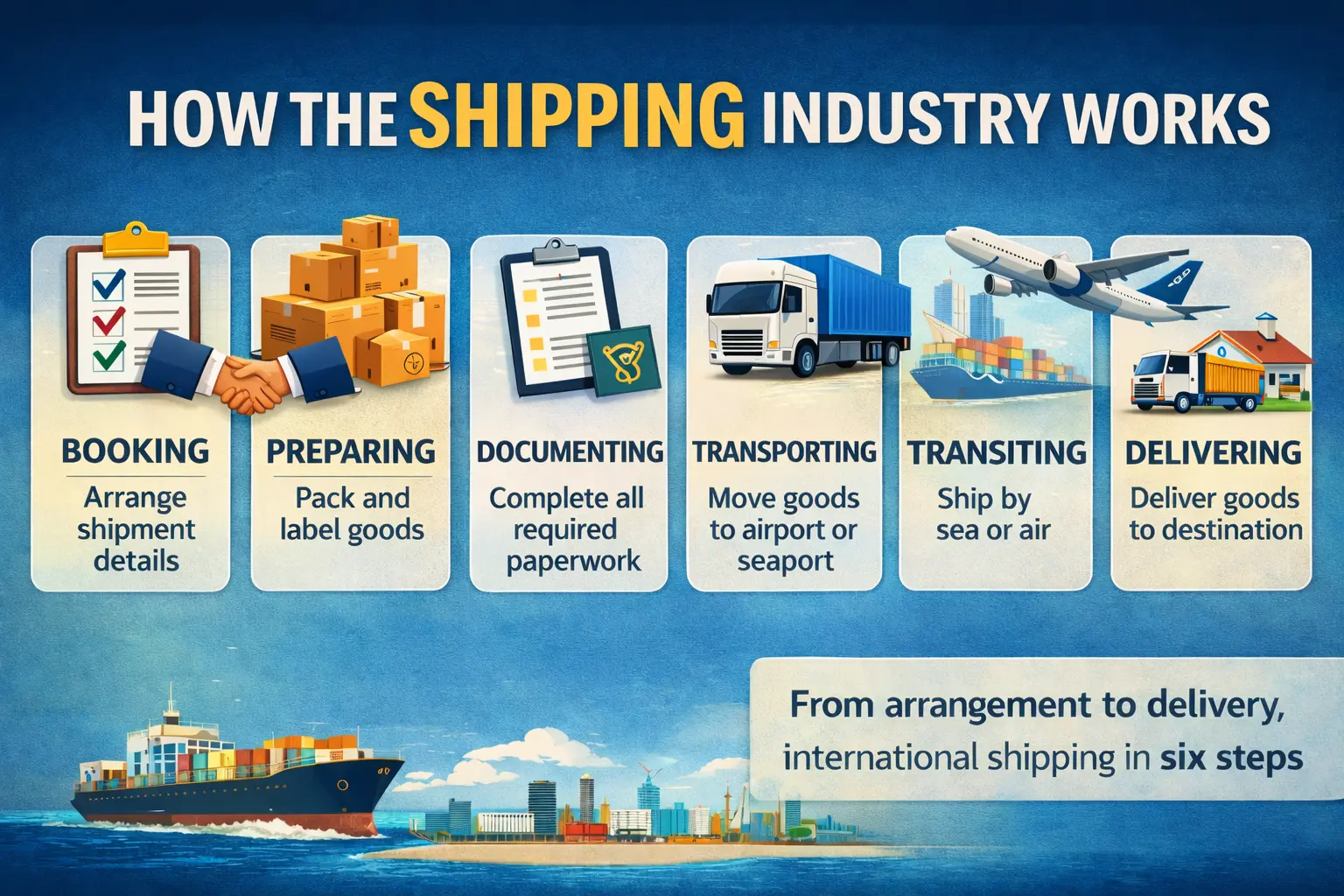
Cross-border transportation of goods does not necessarily make sense but can be made easy. You are either the owner of a business transporting goods or interested in how packages pass across borders, knowing how it works will enable you to make decisions that are more informed.
The shipping sector links up millions of enterprises all over the globe. When you have to transport cargo between one nation to another, it becomes easy to do it through a freight forwarding company in Dubai like Alliance Shipping. Such companies deal with all the complicated paperwork, make arrangements with carriers, and provide the safety of the delivery of your goods to the destination.
And maybe we can deconstruct how the shipping process works, starting when you have something to ship till the time it reaches its destination.
Understanding the Basics of International Shipping
International shipping is the transportation of products across the border by way of different modes of transportation. Ships, planes, trucks, and trains contribute to transportation of products between point A and point B.
It is a process that involves coordination of several parties. The exporters, importers, customs officials, carriers, and freight forwarders are all collaborating to facilitate the movement of cargo in an efficient manner.
Various shipping techniques are applicable in different requirements. Ocean shipping is a good choice when it comes to big and heavy consignments which do not have a time limit. Air freight is more expensive and less time-consuming. This is at your own discretion basing on how much the budget is, your time schedule and you can be shipping anything.
International trade is supported by documentation. You will come across bills of lading, commercial invoices, packing lists and certificates of origin just to mention a few. The lack of documents or incorrect ones can create delays up to days or weeks.
Step 1: Booking Your Shipment
The logistics process starts with the booking. You get in touch with a freight forwarder or carrier to have your goods transported.
You will supply information on the shipment in the course of booking. These are what you are shipping, its weight and size, source, destination and the date you would want delivery to take place. The closer you have the details the smoother it is.
Your freight forwarder will enquire on the type of cargo. There are certain items that should be handled in a special manner. The perishable goods require refrigerators. There are strict regulations of hazardous materials. Delicate items require additional security.
You will be quoted according to your needs. This quote is normally charged with transportation fees, handling charges, and other services you may be demanding. The cost will be different due to the distance, mode of shipping, type of cargo and the prevailing market conditions.
After accepting the quote, you will sign a contract/service agreement. The responsibility, service term and liability are pointed out in this document. Check it thoroughly and then sign it.
Step 2: Preparing Your Cargo
Damages and delays are avoided through proper preparation. The way you pack the goods is as important as the manner in which you ship the goods.
Use the correct packaging materials. Your products are transported in hard-cardboard boxes, pallets, crates, or containers. During its journey, goods will be loaded, off loaded and stacked several times.
Label everything clearly. Add handling instructions, destination information and any warning labels necessary by law. Labeling can make workers take care of your cargo.
Write a comprehensive packing list. This sheet contains details of all the items in your shipment such as quantity, weights and value. It is the information that is applied by customs officials during inspections.
Take into account insuring valuable shipments. There is a limit in standard carrier liability. Further coverage covers your loss or damage.
Step 3: Documentation and Customs Clearance
Documentation may appear to be a lot when in reality, every document has a certain purpose.
The commercial invoice specifies the item shipped and its price. This is used to determine taxes and duties by customs officials. It should be precise and comprehensive.
The bill of lading is the document which acts as the source of receipts, a contract and a title. It provides ownership and shipping instructions. Guard it–you will have to use it to get your goods.
The origin certificates demonstrate the place of manufacture of goods. Certain countries provide special tariffs on goods of certain regions. This certificate would save money.
Licenses of export and import might be needed based on what you are exporting. Special permits are required on controlled goods such as some electronics or some chemicals.
Customs paperwork is usually done by your freight forwarding company in Dubai. They send papers in electronics and liaise with the customs brokers on each side. This knowledge will prevent expensive errors and setbacks.
Step 4: Transportation to Port or Airport
After documentation has been completed, your cargo is transported to the departure point.
In the case of ocean transportation, products are carried to a seaport. This domestic leg is done by trucking companies or rail service. Pickup is organized by your freight forwarder, at your place of location or warehouse.
Airfreight travels through airports which have cargo handling facilities. These are specialized terminals that deal with commercial freight, and do not deal with passenger operations.
Cargo is subjected to security checks at the port or airport. Only authorities check the forbidden objects and check documentation with the actual shipment.
Goods are then packed or loaded in containers. Full container loads (FCL) are set aside to a single shipper. Less than container loads (LCL) is a group of shipments that is composed of various shippers and is loaded into containers.
There is skill in loading containers. Good distribution of weights avoids transit shifts. Bulky items should be placed at the bottom and light ones suggested on top. Goods that are fragile require additional securing.
Shipping From UAE to KSA: A Regional Example
Shipping from UAE to KSA will be one of the busiest trade routes in the Gulf area. Close distance and robust trade relations between the two nations allow free traffic of cargo.
There are several alternatives in this route. The trucking option can deliver a door-to-door service and is effective in cases of urgent deliveries. Ports such as Jebel Ali to Jeddah or Dammam are economical in ocean freight volume.
The transit time through road is usually 24-48 hours, based on the customs. Via sea transport requires between 3 and 5 days at sea, and terminal tasks.
The two countries have simplified the customs processes with electronics. The documentation requirements are however tough. There is a requirement of commercial invoices, packing lists, and certificates of origin.
There are special regulations of some products. Food products should have health certificates. Electronics need conformity certificates. These requirements are taken through your freight forwarding company in Dubai.
GCC custom union eases certain operations when it comes to transporting commodities among member states. These advantages can be learnt and minimize costs and transit time.
Step 5: Ocean or Air Transit
The major part of the journey of your cargo starts when it is loaded into a ship or airplane.
Shipment on the ocean has fixed routes and departures. Container ships hold thousands of containers which are stacked on deck and holds. Depending on the distance and the path, transit times range between days to weeks.
When passing through ports, ships are allowed to make several stops. Each stop makes the cargo loaded and unloaded. This transshipment may lead to an increase in the delivery time at a lower cost.
Air cargo has a greater velocity. The planes are usually direct or having few stops. The majority of air cargo features scheduled flights, although cargo planes operating specific routes are present.
Shipments and delivery are traced by carriers through GPS and other technologies during transit. Updates on the location are real-time and are offered through modern systems. You are able to keep track of your cargo online.
Delays can be due to weather, congestion at the port or mechanical problems. The good freight forwarding company in Dubai notify you of any issues and ensure that disruptions are reduced.
Step 6: Arrival and Import Customs Clearance
After the cargo arrives to the country where it is destined, it falls under import customs clearance.
Officials of the customs examine your paperwork and can search the physical shipment. They ensure that asserted goods are equal to the received goods. They inspect outlawed goods and determine duties and tax payable.
The importation of duties varies according to the classification of products, origin and trade agreements. The cost of customs can be calculated with the help of customs brokers.
Certain deliveries receive expedited clearance by trusted trader programmes. Those companies that have good compliance records are processed faster. Others are subjected to lengthy investigations that may take days.
Duties and taxes should be paid before release of cargo. This is accelerated by electronic payment systems. Late payments translate to a late delivery.
Customs releases your shipment once it has been cleared. The carrier is authorized to deliver your goods with the help of a delivery order.
Step 7: Final Delivery
The final leg is known to transport your cargo to the port of choice or the airport.
This delivery is done by local trucking firms. In the case of businesses, the goods are usually shipped to warehouses or distribution centres. On the consumer side, the goods are delivered to the homes or designated addresses.
The time of delivery is determined by the distance and traffic. Cities tend to be served faster as compared to the country areas.
On delivery, the receivers check on damages to the shipments. Record any apparent damage on the delivery receipt at the time. This record helps in supporting insurance claims where necessary.
Delivery records indicate that the shipment has been made. This is done through signatures, photographs or electronic confirmations. Retain these records in files.
Conclusion
The shipping business is one which involves concerted efforts that facilitate goods transportation across the borders. Since the very first booking up to the final delivery, every phase must be handled with details and correct implementation.
This process will enable you to make informed decisions concerning your shipments. Be it you are shipping products overseas or have been provided with goods by other countries, an idea of what to anticipate minimizes stress and thus eliminates trouble.
Partnering with experienced professionals simplifies international shipping. A reliable freight forwarding company in Dubai brings expertise, networks, and resources that individual shippers can’t match. They turn complex logistics into straightforward processes.
The fundamentals of shipping from UAE to KSA or any international route remain the same. Proper preparation, accurate documentation, and professional coordination ensure your cargo arrives safely and on time.
Read More:
FAB Balance Check: Simple and Fast Ways to Monitor Your Account
Lulu Balance Check: How to Check Your Lulu Card Balance in 2026
Al Hamriya Beach: A Peaceful Public Escape in Sharjah
Grand City Mall Dubai: A Complete Guide for First-Time Visitors