
Now Reading: Why Smart Warehousing Is Critical for Middle East Fulfillment Hubs
-
01
Why Smart Warehousing Is Critical for Middle East Fulfillment Hubs

Growth in e-commerce, retail expansion and cross-border trade continues, and fulfilment hubs across the Middle East are evolving at a rapid pace. These facilities are under pressure to handle higher order volumes, faster delivery expectations and more complex inventory flows. The traditional warehouse models are often not able to match this pace, and this causes inefficiencies in the storage, picking and dispatch operations within the Middle East supply chain network.
This is where smart warehousing comes in. It enables Middle East fulfilment hubs to operate with increased visibility, automation and coordination throughout each stage of the warehouse activity. Warehouses can increase accuracy, minimise delays, and enable scalable operations to meet rising market demand in the Middle East logistics ecosystem by adding intelligent systems such as Addverb’s warehouse automation solutions.
Why Smart Warehousing Is Transforming Middle East Fulfilment Operations
Fulfilment hubs in the Middle East are transitioning from manual, fragmented operations to more connected and automated warehouse environments. The growing order complexity in the Middle East is driving a transformation that requires speed improvements and error reduction.
- Rising e-commerce demand is putting pressure on warehouses
- Fulfilment strategies are changing due to the demand for faster delivery.
- Labour efficiency challenges are pushing automation adoption
- Inventory visibility gaps are creating operational delays
Faced with these challenges, warehouses are increasingly resorting to intelligent systems to improve the coordination of storage, movement and dispatch processes.
How Smart Warehousing Enhances Operational Efficiency in the Middle East
Smart warehousing assists the Middle East’s fulfilment hubs in enhancing data visibility and process coordination throughout the warehouse, thereby optimising operations. It connects the multiple functions such as storage, picking and shipping into one system, thereby reducing the operational gaps.
- Real-time tracking increases the speed of decision-making
- Automated workflows reduce reliance on manual processes
- Better inventory management avoids stock mismatches
- Integrated systems improve coordination across warehouse areas
Such levels of efficiency are especially critical for the Middle East, where warehouses need to handle high throughput but need to be accurate and reliable in fast-moving supply chains.
Role of Automation in Scaling Middle East Fulfilment Hubs
Automation is essential to enable the Middle East fulfilment hubs to scale operations without adding complexity. This means that warehouses can process more and more orders without any loss of performance.
- Automated storage systems improve space utilisation
- Robotics reduce manual handling and operational delays
- System-driven workflows support faster order processing
- Integrated platforms improve coordination across operations
This means that warehouses can boost their capacity without losing speed or efficiency.
How Smart Warehousing Improves Inventory Accuracy and Visibility
One of the biggest benefits of smart warehousing is enhanced inventory visibility. Real-time data tracking guarantees accurate information about stock levels, movement, and order status for warehouse operators.
- Minimises errors in stock counting and allocation
- Enhances order accuracy across fulfilment centres
- Assists in faster replenishment decisions
- Increases transparency across distributed warehouse networks
Such a degree of visibility becomes absolutely necessary to maintain smooth and reliable supply chain operations.
Impact of Smart Systems on Middle East Logistics Performance
Warehouses in the Middle East benefit significantly from smart systems that optimise workflow and reduce inefficiencies. These systems help to ease the coordination of inbound, storage, and outbound processes .
- Faster order processing improves delivery timelines
- Reducing bottlenecks enhances warehouse flow efficiency
- Better resource utilisation lowers operational costs
- Improved system coordination supports consistent performance
This, in turn, allows fulfilment hubs to meet growing customer expectations while maintaining operational stability in high-demand environments.
How Addverb Supports Smart Warehousing in the Middle East
Addverb supports smart warehousing with advanced automation solutions that improve efficiency, accuracy and scalability across fulfilment hubs in the Middle East. Its technologies integrate warehouse operations into cohesive systems that offer better control and visibility.
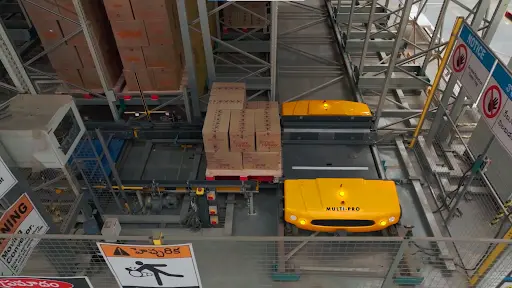
Addverb’s solutions help warehouses in the Middle East manage inventory, automate movement using mobile robots.and optimise fulfilment processes in complex supply chain networks. Addverb enables connected and intelligent warehouse environments to cater to the growing need for high-performance logistics infrastructure.
Conclusion
As supply chains in the Middle East get more complex, smart warehousing is becoming a critical requirement for modern fulfilment hubs. It enhances efficiency, accuracy and scalability, and offers more control over warehouse operations.
Given that the demand in the Middle East is on the rise, an intelligent warehouse system will play an important role in achieving efficient and effective logistics operations. This transformation is being made possible by Addverb through automated systems that are built for future-ready operations.
Read More:
How the Shipping Industry Works: Step-by-Step From Booking to Delivery
How Smart Packaging Supports Dubai’s Growing Last‑Mile Logistics